Showing posts with label mythology. Show all posts

Sunday, December 18, 2011

44 Days of Witchery: Day 9


A favorite mythological animal

The griffin is a creature with the head, wings, and beak of an eagle, the body of a lion, and (occasionally) the tail or a serpent or scorpion. Its origin is unknown, but believed to be either Mongolian, Babylonian, Assyrian or Persian. The myth of these creatures spread through the then-known world, and can be found in cultures such as Egyptian and Asian.

In Greek mythology, they belonged to Zeus. Later, Romans and medieval Europeans used them for decorations. Especially along-side gargoyles on buildings.

It is likely that traders in Mongolia discovered dinosaur fossils and misinterpreted them as the Griffin, but I like to hold out hope that evidence of this Cryptozoological creature actually existed in antiquity.

Thursday, November 3, 2011

44 Days of Witchery: Day 2

Sorry I didn't post yesterday. I'll try not to let it happen again!

A Myth or Story from Folklore

Oisín was a mortal in Ireland who was visited by a fairy woman named Níamh Chinn Óir (Niamh of the Golden Hair), who was the daughter of Manannán Mac Lir (Celtic God of the Sea). She announces that she loves him and he is taken to Tir Na nÓg to live with her.

This marriage produced two children, Oscar and Plor na mBan. After what seems like three years to Oisín, he tells Níamh Chinn Óir that he misses his friends and family in the mortal realm. In reality, it has been 300 years. Níamh Chinn Óir provies him with her horse, Embarr, and gives him a warning. If his feet touch mortal soil, the time he missed will catch up. He would age 300 years, and become old and withered.

Oisín returns to his home to find it abandoned and in disrepair. Later, while trying to help some men who were building a raod, the girth on the saddle broke and he fell to the ground. The horse returned to Tir Na nÓg without the ancient man, and he died of old age some time afterward.

Friday, October 7, 2011

Tantalus

Tantalus was first known for being a mortal guest on Olympus. It is said that he stole ambrosia and nectar, with the idea to bring it back to his people. He also revealed secrest of the Gods to his people. What he's most famous for, however, is a sacrifice he performed.

Tantalus sacrificed his own son, Pelops. He cut up the boy, boiled him, and served him up in a banquet for the Gods. Most of the Gods weren't fooled however, and did not touch the offering. Only Demeter ate the "food", not paying attention to what was going on around her because of the loss of Persephone.

Zeus ordered Clotho, one of the three Fates, to bring the boy back to life. Clotho collected all the parts of the body and boiled them in a sacred cauldron. The missing shoulder was built out of ivory by Hephaestus, and given to Clotho by Demeter. Rhea gave Pelops the breath of life while Pan danced in joy. Pelops emerged with beauty that rivaled the Gods. Poseidon instantly fell in love with the boy, and took him to Olympus in a chariot drawn by golden horses. Pelops became Poseidon's cup-bearer and attendant whenever the sea God visited the palace on Olympus. Later Pelops returned to the world of mortals, and had misadventures of his own.

Tantalus had also committed a third crime, perjury. A golden dog given to Rhea so she had help watching over the infant Zeus (it was said that Hephaestus made the dog, but that doesn't make sense being that Hephaestus is supposed to be the son of Hera). Once it was no longer needed to guard Zeus, the dog was placed in Zeus' temple at Dicte. It was here that the dog was stolen. Eventually Tantalus came into possession of it. When Hermes asked Tantalus about the dog, Tantalus swore an oath by Zeus that he knew nothing about it. Hermes exposed the lie, and discovered the thief.

The Greeks were horrified by what Tantalus had done. Cannibalism, human sacrifice and infanticide were atrocities and as taboo as they are in our society today. Hades' punishment for Tantalus' crimes was to stand in a pool of water beneath a fruit tree with low branches. Whenever he reached for food, the branches moved out of his reach. When he tried to drink, the water receded before he could get a drop. There was also a threatening boulder placed over his head, in punishment for the act of perjury. He was one of the few that received eternal punishment, with no chance to go to the Asphodel Meadows.

Monday, October 3, 2011

Jack O'Lanterns


The term "Jack O'Lantern" originally meant one of two things. A night watchman (who held a lantern to see by) or "will o' the wisp", which are mysterious flickering lights sometimes seen at night over wetlands.

Another meaning comes in the form of a myth. An Irish man named "Stingy Jack" invited the Devil to a drink. Stingy Jack didn't want to pay, so he convinced the Devil to turn himself into a coin so they could pay. Once the Devil had complied, Jack decided to keep the money and put it next to a silver cross, preventing the Devil from changing back. Jack eventually freed the Devil, with the condition that the Devil would not bother him for a year and that the Devil could not claim his soul if Jack died before then.

The next year, Jack again tricked the Devil. This time the Devil climbed a tree to pick a fruit. While the Devil was climbing, Jack carved a sign of the Cross into the bark. The Devil was forced to make another deal. This time, he promised not to bother Jack for ten more years.

Jack died soon after that. According to legend, God would not allow him into Heaven. The Devil, upset by the tricks, kept his word and would not allow Jack into Hell. He sent Jack off into the night with only a burning coal for light. Jack put the coal into a carved out turnip, and began roaming the Earth with it ever since. The Irish began referring to him as "Jack of the Lantern", and later shortened it to "Jack O'Lantern."

In Ireland and Scotland, people began making their own versions of Jack's lanterns by carving scary faces into turnips or potatoes and placing them into windows or near doors to frighten away Stingy Jack and other malicious spirits. The English used beets instead of turnips and potatoes. Immigrants from these countries brought the Jack O'Lantern tradition with them when they came to the United States and quickly discovered pumpkins made perfect Jack O'Lanterns.

Friday, September 23, 2011

Autumn Equinox

The Autumnal Equinox is the second time of the year when day and night are equal in length, the other being the Spring Equinox. The leaves are beginning to turn, except for the evergreen plants, and the birds are beginning to migrate south (or, at least the ones that are less tolerant of colder weather).

It is in our nature to begin to slow down at this time of year. Especially those of us who are of northern European descent. It gets very cold in the northern parts of the world, and conservation of energy is important. We need the energy to help keep us warm in sub-zero temperatures.

Once the harvest is done, there is still work to do. This is the time to can food, or freeze it, so extra is available during the cold winter. Even though humans (for the most part) no longer rely on storing everything we need over the winter, it is still a good idea to have a lot stored. If there's a natural disaster (such as a blizzard) that prevents you from going to the store to get food, you already have plenty on hand.

This time of year is associated with Persephone returning to her husband, while her mother begins to neglect the duties she is commanded to perform.

Thursday, July 28, 2011

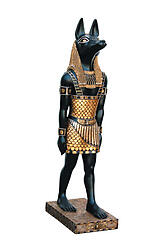
Deity of the Month: Anubis

Anubis is an Egyptian God. Anubis is actually the name given to the God by the Greeks, but it is the most popular so for the remainder of the post I will refer to him as Anubis.

Anubis' animal form is the jackal and is associated with mummification and the afterlife. He was originally the God of the Dead, but was replaced by Osiris in the Middle Kingdom of Egypt.

One of his roles was to decide the fate of the soul. He had a set of scales that determined what reward or punishment the deceased would receive upon arriving in the afterlife. He would place the heart and weight it against a feather. How heavy the heart was determined the fate of the soul.

Thursday, July 21, 2011

Creation according to Greek Mythology

In the beginning, Chaos was surrounded by an unending stream of water that was ruled by the God Oceanus. The Goddess Eurynome desired to make order out of Chaos. By mating with Ophion (Sometimes North Wind, depending on the version you're reading), she gave birth to Eros, who was also known as Protagonus.

Eurynome separated the sky from the sea by dancing on the waves of Oceanus. By doing so, she created great lands to wander. It was then populated by creatures such as Nympths, Furies and Charites, among other beasts and monsters.

By separating Chaos she created Gaea, Uranus and Tartarus. Gaea and Uranus married, followed by giving birth to the Titans. They warned Cronus of a prophecy that his own children would rise up against the Titans. He responded by swallowing his children before they could grow.

Cronus' wife, Rhea, was giving birth to a sixth child when Gaea had an idea to save her grandchild. She took a stone, wrapped it in swaddling clothes, and offered it to Cronus. Thinking the stone was the child, Cronus swallowed it.

Gaea was able to hide the baby, named Zues, in what is now called Crete. With time, Zues grew up, and searched for his parents. He immediately fought with Cronus, who had no idea Zues was his own offspring.

Metis, Zues' first wife, found a way to administer an emetic to Cronus. Zues' older siblings, Hestia, Demeter, Hera, Hades and Poseidon joined Zeus agasinst ther father. They defeated the Titans after a long war, followed by dividing up the universe to bring further order out of Chaos.

Zeus made himself Supreme God over all the other Gods and Goddesses, as well as the mortal beings that wandered over the Earth. He also created a palace for his favored Gods on Mount Olympus in Thessaly. The rest were left to fend for themselves in lands below Mount Olympus.

Zues decided he should be God of the Sky and all associated phenomena. Hestia became the Goddess of the Hearth. Poseidon was given rule over the Sea. Demeter became a Fertility Goddess, and many things associated with fertility. Hera was Goddess of Marriage and Childbirth. And finally Hades was made God of the Underworld.

Zeus, however, did not like the humans. He did not find them beautiful, and being mortal was another strike against them. They also complained about the lack of good food and the cold nights, which annoyed Zeus. He chose to ignore them, while he and the other Gods feasted and enjoyed hearths in every room of their palaces.

Prometheus, who was one of the Titans that did not fight against Zeus, took pity on the humans. He stole some of the sparks from a fire on Olympus and gave it to the humans.

Zeus was furious at the insult to his power, and had Hephaestus fashion a creature to torment Prometheus. It was a woman they named Pandora. She was given a precious and beautiful box, which she was told not to open. But her curiosity won, and she opened the box. All the evils of the world were released, but she managed to close the box before Hope could also escape.

Thursday, July 7, 2011

The Ages of Man according to Hesiod's Works and Days


WORKS AND DAYS , TRANS. BY H. G. EVELYN-WHITE

HYMN TO ZEUS
[106] Or if you will, I will sum you up another tale well and skilfully -- and do you lay it up in your heart, -- how the gods and mortal men sprang from one source.

[109] First of all the deathless gods who dwell on Olympus made a golden race of mortal men who lived in the time of Cronos when he was reigning in heaven. And they lived like gods without sorrow of heart, remote and free from toil and grief: miserable age rested not on them; but with legs and arms never failing they made merry with feasting beyond the reach of all evils. When they died, it was as though they were overcome with sleep, and they had all good things; for the fruitful earth unforced bare them fruit abundantly and without stint. They dwelt in ease and peace upon their lands with many good things, rich in flocks and loved by the blessed gods.

[121] But after earth had covered this generation -- they are called pure spirits dwelling on the earth, and are kindly, delivering from harm, and guardians of mortal men; for they roam everywhere over the earth, clothed in mist and keep watch on judgements and cruel deeds, givers of wealth; for this royal right also they received; -- then they who dwell on Olympus made a second generation which was of silver and less noble by far. It was like the golden race neither in body nor in spirit. A child was brought up at his good mother's side an hundred years, an utter simpleton, playing childishly in his own home. But when they were full grown and were come to the full measure of their prime, they lived only a little time in sorrow because of their foolishness, for they could not keep from sinning and from wronging one another, nor would they serve the immortals, nor sacrifice on the holy altars of the blessed ones as it is right for men to do wherever they dwell. Then Zeus the son of Cronos was angry and put them away, because they would not give honour to the blessed gods who live on Olympus.

[140] But when earth had covered this generation also -- they are called blessed spirits of the underworld by men, and, though they are of second order, yet honour attends them also -- Zeus the Father made a third generation of mortal men, a brazen race, sprung from ash-trees [meliai]; and it was in no way equal to the silver age, but was terrible and strong. They loved the lamentable works of Ares and deeds of violence; they ate no bread, but were hard of heart like adamant, fearful men. Great was their strength and unconquerable the arms which grew from their shoulders on their strong limbs. Their armour was of bronze, and their houses of bronze, and of bronze were their implements: there was no black iron. These were destroyed by their own hands and passed to the dank house of chill Hades, and left no name: terrible though they were, black Death seized them, and they left the bright light of the sun.

[156] But when earth had covered this generation also, Zeus the son of Cronos made yet another, the fourth, upon the fruitful earth, which was nobler and more righteous, a god-like race of hero-men who are called demi-gods, the race before our own, throughout the boundless earth. Grim war and dread battle destroyed a part of them, some in the land of Cadmus at seven- gated Thebe when they fought for the flocks of Oedipus, and some, when it had brought them in ships over the great sea gulf to Troy for rich-haired Helen's sake: there death's end enshrouded a part of them. But to the others father Zeus the son of Cronos gave a living and an abode apart from men, and made them dwell at the ends of earth. And they live untouched by sorrow in the islands of the blessed along the shore of deep swirling Ocean, happy heroes for whom the grain-giving earth bears honey-sweet fruit flourishing thrice a year, far from the deathless gods, and Cronos rules over them; for the father of men and gods released him from his bonds. And these last equally have honour and glory.

[169c] And again far-seeing Zeus made yet another generation, the fifth, of men who are upon the bounteous earth.

[170] Thereafter, would that I were not among the men of the fifth generation, but either had died before or been born afterwards. For now truly is a race of iron, and men never rest from labour and sorrow by day, and from perishing by night; and the gods shall lay sore trouble upon them. But, notwithstanding, even these shall have some good mingled with their evils. And Zeus will destroy this race of mortal men also when they come to have grey hair on the temples at their birth. The father will not agree with his children, nor the children with their father, nor guest with his host, nor comrade with comrade; nor will brother be dear to brother as aforetime. Men will dishonour their parents as they grow quickly old, and will carp at them, chiding them with bitter words, hard-hearted they, not knowing the fear of the gods. They will not repay their aged parents the cost their nurture, for might shall be their right: and one man will sack another's city. There will be no favour for the man who keeps his oath or for the just or for the good; but rather men will praise the evil-doer and his violent dealing. Strength will be right and reverence will cease to be; and the wicked will hurt the worthy man, speaking false words against him, and will swear an oath upon them. Envy, foul-mouthed, delighting in evil, with scowling face, will go along with wretched men one and all. And then Aidos and Nemesis [shame of wrongdoing and indignation against the wrongdoer], with their sweet forms wrapped in white robes, will go from the wide-pathed earth and forsake mankind to join the company of the deathless gods: and bitter sorrows will be left for mortal men, and there will be no help against evil.

****borrowed from The Internet Sacred Texts Archive****


The following is in my own words, and my interpretation of this hymn.


The first age is called the "Golden Age" and is the only one that falls under the rule of Cronus. In this age people lived among the gods, and freely mingled with them. There were no conflicts or wars among the mortals during this age. Humans did not have to work to feed themselves, because the earth provided for them in abundance. They lived to be very old, but never physically grew that old, and eventually died peacefully. Their spirits live on as guardians of mortal humans. These spirits are benevolent and beneficent, helping to prevent illness.

The second age is the "Silver Age", which is the age that existed while Zeus and Cronus fought for power. Men in this age lived for 100 years and did not leave their mother's homes until near the end of their lives. Their actual adulthood was very short, and they spent that time fighting with each other. They refused to worship the Gods, and Zeus was forced to destroy them in punishment. After they died, they became the "blessed spirits" of the underworld.

The third age is known as the "Bronze Age". Men of this age were hard. They lived for war, and every material item they owned was made of bronze, even their homes. This was the first Age that had women as well as men, and were able to procreate unlike the previous two Ages. The men of this age destroyed themselves with their own violent ways and did not become beneficial spirits upon death, and instead dwelt in Hades. This age was ended by the Flood of Deucalion.

The "Heroic Age" is the fourth age, and the only one that doesn't correspond with a metal since the people are the surviving, less violent, Bronze Age members. It is also the only age that improves on the age it follows. In this age men lived with noble Demigods and Heroes. The Trojan War was fought in this age, and the Heroes that are told about in the stories, such as Heracles and Jason, lived during this age. This race of humans went to Elysium upon death.

The fifth age is the "Iron Age". During this time humans work hard for food and material goods, and their lives are full of misery. Children do not honor their parents, siblings fight and Xenia (the social contract between guest and host) is forgotten. During this age might makes right, and evil men use lies to be seen as good. At the height of this age, humans no longer feel shame or indignation at wrongdoing. Babies will be born with grey hair, the gods will completely abandon humanity, and "there will be no help against evil."

Monday, April 11, 2011

Arachne (Updated)


Arachne was a mortal woman (in some stories a princess, others a farmer's daughter) who was a gifted weaver. Not only was the finished product considered art, but the very act of watching her was something to see.

It was said that Nymphs would abandon their fun to watch her weave. Some commented that Minerva (Athena in Greek), the Goddess of crafts, must have taught Arache herself. Arachne was offended by this comment, and announced that she was a better weaver than Athena.

Athena was irritated at Arachne's claim, but decided to give the mortal a chance at redemption. She visited Arachne disguised as a crone and warned the woman not to offend the Gods. Arachne told Athena to save her breath, and that she welcomed a contest with Athena. And she also said that if she lost, she would accept any punishment Athena thought necessary.

Athena welcomed the challenge and revealed her true form. The nymphs shrank back in fear at the sight of the Goddess, but Arachne stood her ground. She had made her claim, and there was no backing down now.

The contest began as each sat before their loom. Athena began to weave the scene of her contest with Neptune (Poseidon in Greek) for the city of Athens. A beautiful scene developed , showing Poseidon and the salt water spring and Athena with an Olive Tree. The bystanders marveled at the work of the Goddess.

Arachne created a tapestry showing scenes of Zeus' infidelity. Leda with the swan. Europa with the bull. Dana and the golden rain shower. The mortal managed to make the scenes life-like.

Athena, even though she had respect for the mortal artist, was offended by the presumptuousness of her choice of subjects. Added to the anger of being challenged, Athena stood and tore Arachne's tapestry to pieces and destroyed the loom. Then she touched Arachne's forehead, making sure the mortal felt guilt for her actions. Arachne was ashamed, but the guilt was too great for her and she committed suicide.

Athena took pity on Arachne, especially because she didn't mean to drive the mortal to suicide. She brought Arachne back from Hades, but not as a human. Instead, Athena sprinkled her with the juices of aconite and transformed the woman into a spider.


Friday, April 8, 2011

Flood of Deucalion


Deucalion was a king in Northern Greece, with Pyrrha as his wife. Deucalion was the son of Prometheus, while Pyrrha was the daughter of Pandora (the first woman). They were born in the time of the Bronze Age of Man, which was a war-like race. This race was very corrupt, and Zeus was angered by their impiety. He sent a great flood to destroy this Age of Men.

Prometheus warned his son and daughter-in-law in time to save them. The couple climbed onto a buoyant chest and sailed to the peaks of Mount Parnassos, which were still dry. Other regions also claimed survivors. King Dardanos sought refuge on Mount Ida. Kerambos was rescued by Nymphs. Megaros fled to mount Gerana. Arkas and Nyktimos were on Mount Kyllene. The tribe of Parnassos fled to high places above Delphi. Io and Epaphos also survived in Egypt.

Zeus and Poseidon caused the waters to recede nine days later. Deucalion, believing they were the only survivors, consulted the Oracle at Delphi (in some versions, it was an Oracle at Themis) about how to repopulate the earth. The Oracle told them to "cover your head and throw the bones of your mother behind your shoulder". After thinking about this, they realized it was a riddle. Both picked up stones, also called the bones of Gaea (the mother of all living things), and tossed them over their shoulders. Each stone Deucalion threw became a man, and each stone Pyrrha threw became a woman.

Sunday, March 20, 2011

Spring Equinox

As mentioned in a list of the eight Sabbats, the Spring Equinox is today. There are many different ways to celebrate, depending on your religion.

Personally, if it's not still winter here in Montana, I take a walk and enjoy the smell of new life that is distinctive after a long, bitter winter. The days are getting noticeably longer (even without the irritating time change) and I'm even able to open a window and let some fresh air inside my apartment.

This is one of two days in the year when the amount of daylight is the same as the amount of darkness. Ancient people in the modern day countries of Germany, Poland, Russia, Norway, Sweden, etc. noticed this and made a special day for it.

The term Ostara is a modification of the name of the Goddess Eostar, who was a patron of spring. She is most often seen as an older maiden or young mother figure, wearing white. Bonfires were a frequent part of the celebration of this holiday.

Pagans share a celebration of the theme of death and rebirth with the Christian Easter (guess where they got that name, by the way). Ancient Pagans who worshiped Cybele held a ritual for her consort, Attis. He was believed to die and be reborn at this time during the spring.

Another ancient story is also a Greek one. Demeter, who was responsible for the harvest and the change of the seasons, never allowed a season of death (winter). Then her daughter, the personification of Spring itself, was kidnapped by Hades to be his wife. In her grief, she ignored her duties and the first winter arrived in Greece. Zeus was uncharacteristically worried about the mortals and animals, and forced Hades to return Persephone. But, before he returned Persephone to Demeter, Hades tricked the young Goddess into eating food of the afterlife. Eating this food meant she was forced to live with Hades. Hermes, however, found a loophole. Since Persephone only ate half of the fruit, she was only required to live with Hades six months out of the year. The Spring Equinox is when Persephone returns to Demeter, resulting in Demeter returning to her duties and bringing Spring back to the world.

Tuesday, March 15, 2011

Types of religious stories

There are several kinds of religious (a.k.a. mythological) stories. Because of the amount of time between when the stories began, and when they were written down, many will overlap. Some may even have elements of all four.

  1. Fantasy
    These stories were invented purely for entertainment purposes. There is as much reality in them as there is in the Harry Potter series.

  2. Fable
    These stories were invented to teach children, and older newcomers to the society, how to live peacefully with the group

  3. History
    These stories have a basis in something that really did happen long ago. But, like a giant rumor mill, these stories changed. Some things were added, and others forgotten. It is a challenge to find the truth among the fiction.

  4. Science
    Now, I do realize that these stories are rarely scientifically accurate. I do, however, understand what our ancestors might have thought. They saw things happening around them, and created a story to explain the why and how. It is no longer science, because we have (for the most part) discovered what's really going on. But they do give insight into how people thought thousands of years ago.

Label Cloud

101 2011 2012 44 days of witchery ability activism agnosticism air alberta altar ancestor anubis apatheism apocalypse apollo aquarius arachne arts athame atheism athena autotheism autumn banner beliefs bigotry bottle burning times calendar canada candle celtic child children's christian christmas cleaning coexist common man correspondences crafts creation cryptozoology cycle dalai lama deism deity deity of the month demeter deucalion E3 egypt electronic entertainment expo electronics elements end of the world endymion equality equinox extinction feast festival festivus fires flood food fur g4 gaea gaming germany glass god goddess great flood great spirit greek green griffin halloween hanukkah health henotheism herbalism history holiday holidays hospitality instructions international internet irish italian jack o'lantern kathenotheism kwanzaa lakota lavender leather life luna magic magical place makoshika meatless monday microsoft minerva mjöllnir monolatrism monotheism mothers mythology native american nature norse oil oisin ostara pagan pagan values month paganism pandeism panentheism pantheism pelops pepitas persephone philosophy pipa pirate politics poll polydeism polytheism prayer prayer chain preternatural prophecy pumpkin pyrrha rant Recipes religion religious roman rules sabbat sacred element samhain saturnalia seasons seeds selene shrine sioux sol invictus solstice sopa spider spiritual element spiritualism spring stories sun sign sword of truth symbol tantalus thor three tir na nog tools triad trials trio triskele values vegan vegetarian veneration viking vinegar warlock water wax wheel wheel of the year wicca winter witch witchcraft wizard xenia year yule

Popular Posts