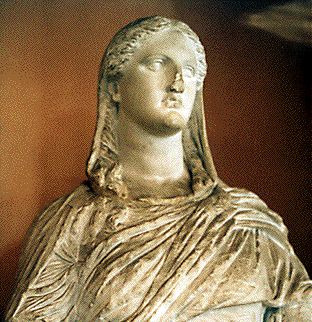
Demeter (Ceres in Roman) was one of the original six Olympian Deities. Her parents were Cronus and Rhea, the rulers of the Titan deities. Cronus believed that if he had any children, they would rise up against him. So he consumed every child his wife gave birth to.
She was the Goddess of the harvest. As such, she presided over grains, the fertility of the soil, and the seasons. She also presided over the sanctity of marriage, the sacred law, and the cycle of life and death.
Demeter is known to be responsible for autumn and winter because her beloved daughter is separated from her. I told this story in a previous post. She is also the main persona we now refer to as "Mother Nature", even though several other deities are combined with her to become this new deity.
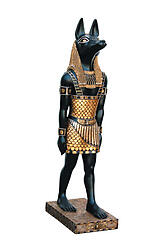
Anubis is an Egyptian God. Anubis is actually the name given to the God by the Greeks, but it is the most popular so for the remainder of the post I will refer to him as Anubis.
Anubis' animal form is the jackal and is associated with mummification and the afterlife. He was originally the God of the Dead, but was replaced by Osiris in the Middle Kingdom of Egypt.
One of his roles was to decide the fate of the soul. He had a set of scales that determined what reward or punishment the deceased would receive upon arriving in the afterlife. He would place the heart and weight it against a feather. How heavy the heart was determined the fate of the soul.
Thor is a hammer-wielding god associated with thunder, lightning, storms, oak trees, strength, destruction, fertility, healing, and the protection of mankind. He is one of the most mentioned deities from pre-Christian Germany. In the Viking era, when Christianity was spreading, the Mjöllnir was worn in defiance and Norse pagan personal names containing the name of the God reveal his popularity. In modern days, Thor continues to be acknowledged in rural folklore throughout the Germanic region. He is also referenced in the day Thursday (Thor's Day).
In Norse mythology, numerous talkes and information about him are found. He is described as having red hair with fierce eyes. He has fourteen different names and is the husband of the Goddess Sif. His mistress is the jotunn jötunn Járnsaxa. With Sif he fathered Þrúðr, and possibly the valkyrie. With Járnsaxa he fathered Magni. With an unknown mother he fathered Móði, and is the step-father of hte God Ullr. His parents are Odin and Fjörgyn. He also has numerous brothers.
He has two servants, Þjálfi and Röskva, and rides in a chariot led by two goats named Tanngrisnir and Tanngnjóstr (that he eats and resurrects). He is known to have three homes (Bilskirnir, Þrúðheimr, and Þrúðvangr). His weapon is the mountain-crushing hammer, Mjöllnir, wears the belt Megingjörð and the iron gloves Járngreipr, and owns the staff Gríðarvölr.
Pallas Athena (Minerva in Roman) was the Goddess of wisdom, civilization, warfare, strength, strategy, female arts, crafts, justice, heroic endeavor, philosophy, and skill. She was also a common companion of Heroes and was the patron of Athens, the city named after her. Another thing she was known for was being one of the three virgin Goddesses.
The most popular story of her birth is that Zeus (Jupiter in Roman) had an affair with Metis. Afterwards, he discovered that any children he had with Metis would be greater than himself. As a result, he swallowed Metis to prevent a pregnancy. What he didn't know was that she was already pregnant with Athena. Metis gave birth to Athena and nurtured her inside Zeus until he complained about headaches. Hephaestus (Vulcan in Roman) split open his head with his smithing tools. Athena burst from his forehead fully grown and armed with weapons.
Other tales of her birth are that she was created parthenogenically as a daughter of Metis. Another story is that she came from another pantheon and was "adopted" by the Greeks as an Olympian.
Athena never took a lover or a consort, and became the enforcer of rules of sexual modesty and ritual mystery. As a result of this, she never gave birth. Not even parthenogenically. However, some stories say she adopted at least one child.
Hephaestus once attempted to rape Athena, but she escaped. His semen fell upon the earth and impregnated Gaea, creating Erichthonius. Gaea gave the baby to Athena to raise the baby as her foster mother. Once he was grown, became the founder of Athens, and its first king. Many beneficial changes to Athenian culture could be traced back to him.
Athena competed with Poseidon (Neptune in Roman) to be the patron deity of Athens, which hadn't been named yet. They agreed each would give the people of the city a gift, and whichever gift the people preferred would name the patron deity. Poseidon struck the ground with his trident and created a spring, giving them a way to trade, not to mention easy access to fresh water. Athena offered them the first domesticated olive tree. The current king of the city, Cercrops, accepted the olive tree on behalf of the people. He also named the city after their patron deity.
She created Medusa, then guided Perseus in his quest to behead the monster. She helped Heracles skin the Nemean Lion, defeat the Stymphalian Birds, and navigate the underworld. She helped Odysseus on his voyage home after the Trojan war and win his kingdom back upon arriving home. She also created the first spider, Arachne.
Selene (Luna in Roman) was a lunar deity. Her parents were the Titans Rhea and Hyperion. She fell in love with a mortal king named Endymion who reined in Asia Minor. She asked Zeus, her cousin, to grant Endymion to grant him eternal sleep so that he would never age, and never leave her. Endymion himself made the decision to sleep forever. Every night Selene slipped down behind Mount Latmus near Miletus to visit him. His sanctuary at Heracleia still exists as a horseshoe shaped chamber with an entrance hall and pillared forecourt.
Selene and Endymion had fifty daughters, the Menae. Selene also had a daughter with Zeus, and some sources claim she was the mother of the Nemean Lion.
In Roman mythology, she drove a chariot drawn by white oxen. In Greek, it was drawn by long-maned horses.
Eventually, she would be replaced as the primary lunar deity by Artemis (Diana in Greek).
Persephone, or Proserpina in Latin, began life as a daughter of Zeus and Demeter. As a Spring Goddess, one of her responsibilities was the growth of flowers. She was doing her job when Hades spotted her from Tartarus. He immediately opened a chasm in the Earth and grabbed Persephone. No one, with the exception of Zeus and Helios, had noticed the abduction.
Demeter's heart was broken over the loss of her beloved daughter. She began wandering the Earth, searching, until Helios revealed what he had seen. Demeter was immediately filled with anger and went into solitude. Her absence was noticed immediately, because the plants ceased to mature or be fertile.
Knowing that if this continued the life that grew upon the earth was in serious jeopardy, Zeus sent Hermes down to Hades to force him to release Persephone. Hades reluctantly agreed, but before she left his palace he gave her pomegranate seeds (in some versions it's the entire pomegranate). In her joy, she forgot that no one must eat the food of Hades, and ate part of it. She was immediately bound to the underworld forever. Quick thinking on the part of Hermes found a loophole. Since she only ate half, she only had to be apart from her mother for six months instead of the entire year.
When Persephone is with Hades, Demeter refuses to allow anything to grow, causing the seasons of Autumn and Winter. During this time Persephone is Queen of the Underworld.
In anticipation of Persephone returning to her, Demeter returns to her duties and Spring soon follows. During this time Persephone is Goddess of Spring.